
Lessons from Lebanon: Could Iran Also Conquer Your City?

Spotify
Youtube
Apple
Subscribe to the TRIBE:
Hezbollah’s Long March: How Iran Built a Power Inside Lebanon—and Why the World Should Pay Attention
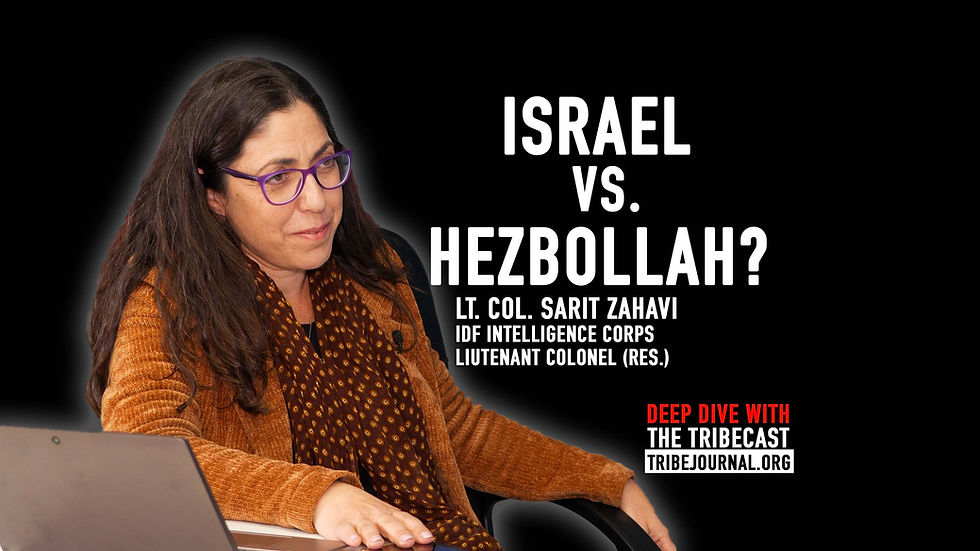
For decades, the story of Hezbollah has often been framed narrowly as a regional security issue between Israel and Lebanon. But according to Israeli security expert Lt. Col. (Res.) Sarit Zehavi, the rise of Hezbollah represents something far more significant: a blueprint for how a hostile ideology, backed by a foreign state, can gradually infiltrate and reshape an entire society.
Speaking from Israel’s northern border, where she lives only a few miles from Lebanon, Zehavi—founder of the Alma Research and Education Center—describes Hezbollah’s evolution not as a sudden military phenomenon but as a slow, strategic social project supported by Iran.
Understanding how this transformation occurred, she argues, may offer a warning for cities and democracies far beyond the Middle East.
Life on the Border
The conversation with Zehavi began with the immediate reality facing Israelis near Lebanon. Communities along the border have spent years living under intermittent rocket and drone attacks from Hezbollah.
The geography itself makes the region difficult to defend. Israeli towns sit close to the border fence, surrounded by hills, forests, and valleys—terrain that makes infiltration and rocket fire easier from the Lebanese side.
After Israel withdrew from southern Lebanon in 2000, the hope was that the border could be defended without maintaining a security zone. But tensions escalated again with the outbreak of the 2006 Lebanon War, when Hezbollah launched attacks and kidnapped Israeli soldiers.
The war ended with United Nations Security Council Resolution 1701, which required that armed militias be removed from southern Lebanon below the Litani River.
According to Zehavi, that never happened.
Over the next two decades, Hezbollah expanded dramatically. By 2023, she says, the organization had transformed from a guerrilla force into what she calls a “terrorist army,” embedding weapons throughout civilian neighborhoods.
“When Israeli forces entered Lebanese villages,” she explained, “they found weapons in almost every house.”
Today Hezbollah still maintains tens of thousands of rockets and drones. For residents of Israel’s north, daily life revolves around bomb shelters and warning sirens.
But the military threat is only the visible part of the story.
The Origins of Hezbollah
Hezbollah was founded in 1982 during the Lebanese civil war. Initially it was a small militia emerging from Lebanon’s Shiite Muslim community, which historically had been one of the country’s poorest and most marginalized groups.
Very quickly, however, the organization gained a powerful patron.
After the 1979 Iranian revolution, the new Islamic government in Tehran sought to export its revolutionary ideology across the region. Iran began providing Hezbollah with funding, training, weapons, and ideological guidance.
Within months, Iran recognized Hezbollah’s potential as a strategic proxy.
Hezbollah’s early ideology openly called for an Islamic revolution in Lebanon modeled on Iran’s system. Its leaders pledged loyalty to Iran’s supreme leader and embraced slogans such as “Death to Israel” and “Death to America.”
But the group’s real breakthrough came later, under the leadership of Hassan Nasrallah.
The Strategic Shift: Society Before Soldiers
In the mid-1990s, Nasrallah made a crucial strategic decision: Hezbollah would become more than a militia.
It would become a society.
The key insight was simple. Military strength would ultimately depend on the loyalty of the population. If Hezbollah could mobilize Lebanon’s Shiite community—socially, economically, and politically—it could build a powerful and sustainable fighting force.
So Hezbollah expanded into virtually every aspect of daily life.
The organization established:
Schools and educational programs
Hospitals and medical clinics
Banks and financial services
Fuel distribution networks
Food programs and charity services
Youth groups and sports programs
Reconstruction projects after conflicts
If a family needed food, medicine, or housing repairs, Hezbollah often provided it.
This created a powerful dependency.
“The society becomes mobilized for the cause,” Zehavi explained. “People send their sons to join the militia, or they hide rockets in their homes.”
This strategy—combining social welfare with ideological indoctrination—allowed Hezbollah to transform its base of support into a large military apparatus.
Today the group reportedly fields around 50,000 fighters with an additional reserve force of similar size.
From Militia to Political Power
Hezbollah’s social influence eventually translated into political power.
Lebanon’s political system divides authority among religious sects—Christians, Sunnis, and Shiites—through a complex power-sharing arrangement. While Hezbollah could not simply dominate the government outright, it gradually gained seats in parliament and influence within governing coalitions.
Over time, Hezbollah became a central player in Lebanese politics.
Even politicians from other religious groups sometimes formed alliances with the organization, either for strategic reasons or due to Hezbollah’s growing influence.
Meanwhile, critics inside Lebanon often faced intimidation, threats, or political marginalization.
The result was a paradox: Hezbollah remained officially a militia, yet it also became embedded within the state.
This dynamic helps explain why Lebanese authorities rarely enforce international demands to disarm the group—even when required by agreements such as UN Resolution 1701.
Many officials simply fear triggering another civil war.
The Generational Effect
Perhaps the most powerful aspect of Hezbollah’s strategy has been time.
The organization has now spent more than forty years shaping institutions, education, and social networks within Lebanon’s Shiite community.
That means multiple generations have grown up inside Hezbollah-run schools, charities, and cultural systems. Changing those loyalties is extremely difficult.
Even during times of war or displacement, support for Hezbollah often remains strong.
“People may complain,” Zehavi said, “but it’s like loyalty to a soccer team. They might want to change the coach, but not the team.”
A Model for Global Infiltration?
For Zehavi, the broader lesson extends far beyond Lebanon.
Iran’s strategy—building influence from the grassroots level through education, welfare networks, and ideological messaging—could theoretically be applied in other societies.
In democratic countries, she warns, such movements may exploit freedoms like free speech and religious liberty to build influence over time.
The process begins locally:
Establish schools or cultural institutions.
Provide community services and financial support.
Cultivate loyalty and ideological alignment.
Develop networks that eventually translate into political influence.
In Lebanon, this process unfolded in a society where Shiites already represented a large demographic group. But Zehavi believes similar strategies could still operate effectively on smaller scales elsewhere and in different forms based on the laws, norms and culture of each country.
Education, she argues, is the most powerful long-term tool.
“Education is the source of power,” she said. “If you educate a generation not to believe in your democratic values, the next generation will not defend those values.”
A Warning from the Border
For Zehavi, the ultimate definition of victory in Israel’s conflict with Hezbollah is far simpler than geopolitics.
“Victory for me,” she said, “is that my daughter can go to school for a full year without war.”
But the story of Hezbollah carries implications well beyond the Israeli-Lebanese border.
It shows how ideological movements can build influence quietly—through schools, charities, and social services—long before they appear as military threats.
And it raises a difficult question for democracies everywhere:
How do open societies defend themselves against movements that use freedom itself as a tool to undermine it?
Lebanon’s experience suggests the answer may determine whether future conflicts begin on battlefields—or in classrooms.
Spotify
Youtube
Apple
Subscribe to the TRIBE:


Comments