
She Has 9 Kids. So Why Is She Doing Someone Else’s Laundry? | Achayot (Sisters)

They expected 200 or 300 volunteers. Within 24 hours, 1,400 Haredi women said, “I’m in.”
The laundry was an embarrassment.
A mother of four describes meeting the woman who had offered to help her. They went for coffee near her home. The volunteer, Esti, had nine children, a business, and a life already crowded with responsibilities.
Why, the mother wondered, would Esti take on her washing?
She needed the help. That much was clear. But accepting it meant handing over something she felt she ought to be managing herself. Four children generate a considerable amount of laundry. Letting a stranger see how much had accumulated felt different from admitting, in general terms, that things were difficult.
Eventually, she accepted.
The Esti later describes getting into her car and crying. Meeting the women carrying their households through months of war had changed her understanding of them.
“I knew it,” she says, “but now I feel it.”
The film moves between these two experiences: the discomfort of needing help and the discovery that comes from giving it. Each woman encounters something she could not quite understand from a distance.
Before the door opened
Before October 7, distance was a defining feature throughout Israel.
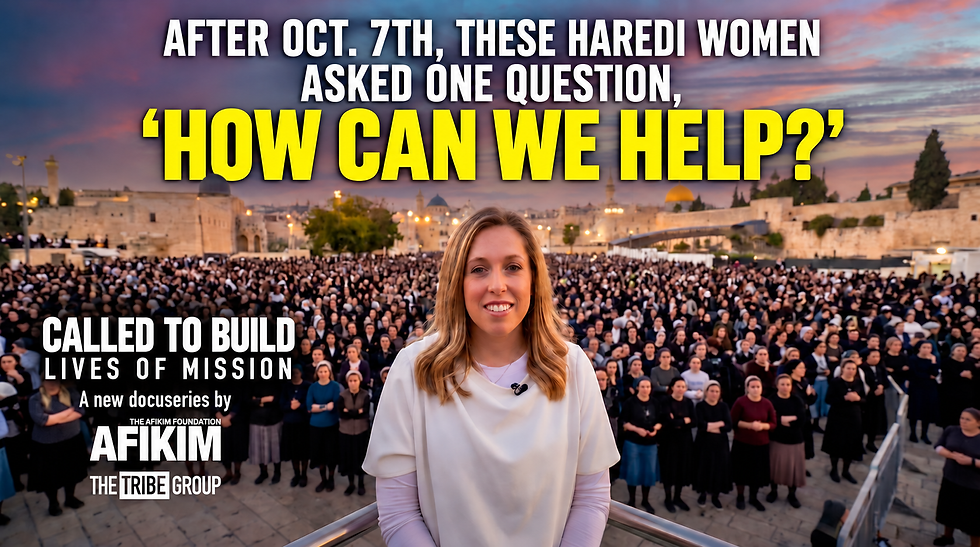
Chana Iram, the Haredi woman who organized the volunteer effort which later became Achayot (Sisters), recalls an Israel divided by the dispute over judicial reform. Demonstrations filled the streets. Within her Haredi community, she felt the pain of being discussed by people who had little contact with the women whose lives they were describing.
“People are talking about us,” she says, “but not with us.”
Then the war began, and her attention turned to the people who needed help.
Volunteering was already familiar territory. Chana describes a community in which helping others was woven into everyday life. Much of that help, however, circulated within the community itself. The relationships were there. People knew whom to call.
Now she wanted to bring that capacity to women beyond those familiar circles.
The invitation was simple: women helping women, sister to sister.
The organizers thought perhaps 200 or 300 women would join. According to Chana, 1,400 Haredi women responded within 24 hours.
A friend who had recently opened a wig store offered them a place to work. Chana, her friends, her daughters, and her mother arrived with laptops. She recalls days beginning at eight in the morning and continuing until midnight.
Calls came from women who needed help and women who wanted to give it. The work was to connect them.
Behind the extraordinary response lay a practical task: find one woman who could be there for another.
What showing up looks like
By the time of our interview, Chana reports that Achayot had grown to 4,700 volunteers across the country. She says three-quarters worked full-time. Many had children of their own.
Once a week, they left houses that still needed attention and went to someone else’s.
Their work was intimate and ordinary: bringing a hot meal, washing dishes, helping with children, doing laundry.
One mother who's husband has served seven tours as a reservist explained that their daughters were very young when the war began. She needed help with both the children and the house.
Achayot paired her with Zehava.
The mother describes the phone call as a “beam of light.” When Zehava arrived, she helped with whatever was needed. What remains with the mother is the experience of having someone there for her.
That presence matters to the story. Household work repeats. A meal is eaten. Clean clothes are worn. Children need attention again tomorrow. Help that returns the following week can become something a family learns to rely on.
And returning gives the women time to know each other.
An acquaintance begins with an introduction. A friendship has room for the untidy details: how tired someone is, what her children need, which part of the week she finds hardest.
The laundry gives those details somewhere to emerge.
The difficulty of saying yes
It is tempting to tell a volunteering story entirely through the generosity of the person who steps forward. The mother of four gives this film another dimension.
Receiving help requires a decision too.
She could see how busy her volunteer was with her own life and managing her own business. That made the offer more moving, but also harder to accept. Why should a woman with nine children and a business take responsibility for the washing in a house with four?
The offer made no sense if availability was measured only by how little someone had to do.
Yet there she was.
For the recipient, accepting meant allowing another person into a vulnerable part of her life.
For the volunteer, entering that life brought an understanding that sympathy alone had not supplied.
“I knew it. But now I feel it.”
The sentence leaves room for the limits of what we think we know about each other.
A sisterhood, one household at a time
Achayot’s numbers convey the scale of the response. The women’s accounts explain what those numbers contain.
A phone call answered. A weekly visit. A mother who can admit she needs help. A volunteer who leaves with a deeper appreciation of the woman she has just met.
The political disagreements that preceded the war are larger than any one friendship. The thousands of volunteers offer no reason to pretend they have disappeared.
However, women are now building deep friendships across boundaries that once kept them apart.
The laundry still needs doing.
This week, someone is coming to help.
Watch Achayot (Sisters), part of Called to Build, for the women’s stories in their own words.
Called to Build explores the people, decisions, and defining moments that build lives of mission. Through personal conversations and powerful stories, meet the visionaries turning ideas into action for the Jewish people—and discover what happens when someone decides, “This is mine to do.”
A TRIBE Journal series in partnership with the Afikim Foundation.


Comments